
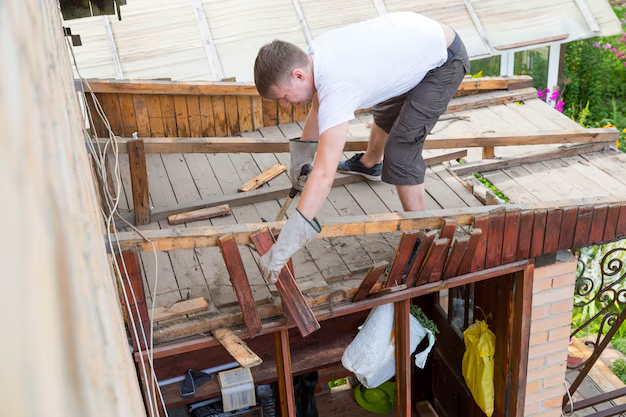
You’re out on the back deck, leaning against the railing to watch the kids play in the yard, and it shifts. Not a lot. Just enough to make you wonder. You push it again. Definitely moving.
Is it a problem? Or just one of those things you’ll get to eventually?
Here’s the short answer: A wobbly deck railing is rarely “just annoying.” In most cases, it signals a structural issue that could put your family at real risk, especially if you have kids running around or guests leaning on it at a backyard cookout. And in Bucks County, where wood decks face freeze-thaw cycles, heavy summer humidity, and decades of use, the causes tend to be more serious than a loose screw.
Let’s walk through exactly what’s happening, what it costs to fix it, and how to decide whether a repair or full replacement makes more sense for your situation.
Why a Wobbly Railing Is a Code Problem, Not Just a Comfort Problem
Building codes in Pennsylvania, and specifically under IRC (International Residential Code) standards, followed in Bucks County require deck railings to withstand a minimum 200-pound lateral load. That’s a grown adult falling or pushing against the railing with full body weight.
If your railing wobbles under a two-handed push, it is not meeting code. That’s not a gray area.
It’s a failure, and if someone were to fall through or over it, the homeowner bears liability.
This matters practically because a railing that appears “fine” can fail suddenly rather than gradually. Wood that looks okay from the outside may be 80% rotted through at the base. Hardware that has been held for ten years can give way the next time real force is applied.
The Three Most Common Causes in This Region
After inspecting decks across Bucks County, from neighborhoods near New Britain Road to homes backing up to the Perkiomen Valley, we see the same culprits over and over.
1. Post Base Rot
Deck posts that sit on or near ground level are the most vulnerable point on any older deck. Even with pressure-treated lumber, the area where the post meets its base bracket collects moisture year after year. Once rot sets in, the post loses its structural integrity from the bottom up. The railing above looks fine. But the foundation beneath it has softened.
In Pennsylvania’s climate, this tends to accelerate after the third or fourth hard winter. If your deck is over 10 years old and the posts are close to the decking surface, not elevated on proper standoff hardware, post base rot is worth investigating.
2. Corroded or Loose Hardware
The bolts, carriage screws, and post-to-rail connectors that hold your railing together are doing a lot of work. When they’re galvanized correctly and installed into solid wood, they can last decades. But standard hardware in a moist environment corrodes. When it does, the connection loosens, and even if the wood is structurally sound, the railing wobbles.
This is actually the most fixable scenario. If caught early, replacing hardware is a straightforward repair with minimal cost. The problem is that homeowners often don’t notice until the corrosion is so advanced that the surrounding wood has also been compromised.
3. Failed Ledger or Post-to-Beam Connection
If the wobble isn’t isolated to one section but affects the whole railing run, the problem may be further down the structure at the ledger board (where the deck attaches to your house) or at the main beam-to-post connections. These failures feel like a general “swaying” in the entire deck frame rather than a localized wobble at one post.
This is the most serious scenario and one that warrants a professional structural assessment before anyone uses the deck.
Fix or Replace? A Practical Decision Guide
Not every wobbly railing means you need to tear out the whole deck. But not every repair is worth doing, either. Here’s a straightforward way to think about it.
| Repair Usually Makes Sense When… | Replacement Likely the Better Value When… |
| Hardware is loose, but wood is solid | Multiple posts with deep rot at base |
| One or two posts show surface-level rot | Wobble extends across the entire railing run |
| Railing section under 8 feet wide | The deck frame shows signs of sag or separation |
| The deck frame and ledger are structurally sound | The ledger board is pulling away from the house |
| Deck is under 15 years old | The deck is over 20 years old with an unknown build history |
The cost difference matters here. A hardware repair on a single post section might run $150 USD – $400 USD, depending on access and materials. Replacing a rotted post and base correctly with proper standoff hardware and new pressure-treated lumber typically runs $400 USD – $900 USD per post. A full railing replacement on a standard deck runs $1,800 USD – $4,500 USD.
What we tell most homeowners: if you’re paying for repairs on more than two or three posts, or if the underlying deck frame has its own issues, the math often favors a full railing replacement. You get new material, proper current-code installation, and peace of mind for only modestly more than piecemeal repairs.
Can You Fix It Yourself?
Some repairs are genuinely DIY-friendly. Tightening a loose bolt, replacing a rusted post cap, or even swapping out a single baluster are weekend-afternoon tasks for a confident homeowner with basic tools.
Where DIY gets risky is anything involving post replacement or attachment to the main deck frame. Getting these wrong doesn’t just mean the railing wobbles again in six months, it means it could fail under load in a way that wasn’t obvious when you finished the project. The 200-pound lateral standard isn’t tested by eye; it requires proper hardware, correct fastener schedules, and solid wood to attach to.
What We See on Decks Specifically
A lot of the decks we inspect in this area were built in the 1990s and early 2000s, with solid construction at the time, but are now hitting a natural end-of-life for original hardware and post bases. The Indian Valley’s climate isn’t extreme by Pennsylvania standards, but it’s wet enough in spring and cold enough in winter to accelerate the decay cycle on any deck that wasn’t built with proper drainage and standoff hardware.
We also see a lot of decks that were added on during a home renovation and never pulled a permit. These sometimes have undersized posts, incorrect railing heights, or baluster spacing that wouldn’t pass a modern inspection. If you’re not sure whether your deck was permitted, that’s worth knowing, especially if you’re thinking about selling the home.
Core One Construction works with homeowners throughout the region, whether you’re near the center of Souderton, out toward Lansdale, or closer to Doylestown, and we give you a straight answer on what’s actually wrong and what it will actually cost.
Get a Free Deck Safety Assessment
If your railing wobbles, don’t wait for a party or a hard lean against it to find out how serious it is. We offer free on-site safety assessments for homeowners in Bucks County and the surrounding area.
We’ll check your railing connections, post bases, hardware condition, and overall deck frame, and give you a clear written assessment of what needs attention and what can wait. No pressure, no upsell, just honest information from a local crew that does this work every day.